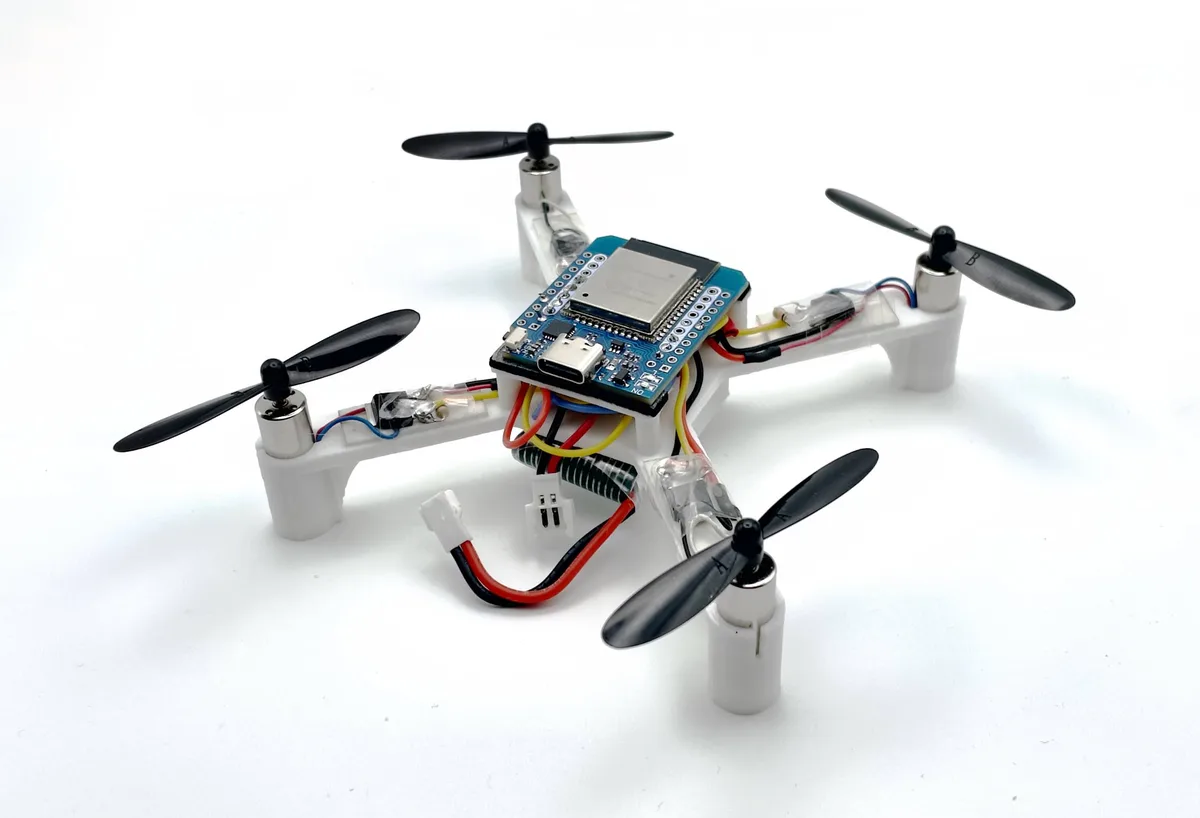
Low-Cost Acoustic Drone Detection: The ESP32 Power of Batear
Commercial drones have transitioned from luxury toys to common tools. However, their unauthorized presence over private property, farms, or sensitive areas introduces major security and privacy dilemmas. While industrial setups deploy expensive military-grade RADARs or thermal cameras, the maker community has stepped up with an ultra-affordable alternative.
An alternative to this is Batear, an open-source project highlighted by developer TN666. For less than $30 in off-the-shelf hardware, Batear transforms a standard ESP32-S3 micro-controller into an autonomous, localized acoustic drone detector.
The Core Concept: Listening to the Sky
Drones emit a distinct, high-pitched whining sound generated by the rapid rotation of their multi-rotor blades. Batear capitalizes on this specific acoustic signature to identify drones entering its immediate airspace.
Instead of relying on heavy cloud computing or expensive hardware, Batear executes Edge Computing directly on-chip. It samples the ambient environment through an I2S microphone, completely offline, ensuring total privacy.


The Two Faces of Batear: Compromise vs. Cost
While Batear is a brilliant piece of software engineering, it is important to look at it realistically. It represents a classic engineering trade-off: extreme accessibility vs. raw performance.
The Pros & Cons Matrix
| The Bright Side (Pros) | The Dark Side (Cons) |
|---|---|
| Cheap: Costs less than $30 to build. | Blind Spotting: Cannot estimate drone distance or direction. |
| Privacy First: No audio is recorded or streamed online. | False Positives: Wind, cicadas, or leaf blowers can trigger it. |
| Ultra-portable: Runs on small LiPo batteries or solar cells. | Fixed Frequencies: Struggles if a drone flies at atypical rotations per minute. |
| Smart Home Integration: Native MQTT auto-discovery. | Short Range: Limited detection radius compared to multi-mic arrays. |
The Verdict: Batear is not a military-grade anti-drone shield. It is an excellent, budget-friendly early-warning tripwire for your smart home.
Acoustic Drone Detection: Batear vs. Industry Standards
To understand why Batear is so cheap, we need to compare its single-microphone method with the advanced acoustic processing used in commercial security today.
| System | Microphones | Result |
|---|---|---|
| Traditional System | Microphone Arrays (TDOA / Beamforming) | 3D Tracking |
| Batear System | Single I2S Microphone (Goertzel Filter) | Simple On/Off Trigger |
Here are the three most common professional techniques used in acoustic surveillance:
1. Beamforming (Acoustic Cameras)
Commercial systems utilize Microphone Arrays (multiple microphones arranged in a geometric circle or sphere). By applying spatial filtering algorithms like Delay-and-Sum, the system creates a dense Acoustic Energy Map. It essentially turns sound into a visual heatmap, allowing security teams to pinpoint the exact 3D coordinates (azimuth and elevation) of the drone.
- Learn more: Read up on advanced spatial filtering via the European Acoustics Association Documentation.
2. TDOA (Time Difference of Arrival)
When a drone emits sound, that sound wave hits different microphones at slightly different times (down to microseconds). By calculating this phase delay across a distributed network of sensors, a TDOA triangulation algorithm can instantly calculate where the drone is moving.
- Deep dive: See how TDOA handles real-world tracking on Acta Acustica.
3. Machine Learning on Mel-Spectrograms
Instead of listening for flat frequencies, traditional tech converts audio into a visual image (mel-spectrograms representation). A Convolutional Neural Network (CNN) then checks the image for signatures, separating real drones from birds or ambient city noise with high accuracy.
Where does Batear fit in?
Batear strips away the expensive array math. It uses a single microphone and the Goertzel Algorithm—a highly efficient DSP (Digital Signal Processing) filter. Instead of scanning the entire audio spectrum like a Fast Fourier Transform (FFT), it calculates the signal energy for just a few precise frequencies (the harmonics of common DJI rotors). It is lightweight enough to run effortlessly on the ESP32-S3's vector instructions, sacrificing 3D tracking to achieve unmatched affordability.
Hardware Blueprint (BOM)
Building a node requires minimal components:
- MCU: Heltec WiFi LoRa 32 V3 or any standard ESP32-S3 development board.
- Microphone: ICS-43434 or INMP441 (I2S digital MEMS microphones).
- Enclosure: A 3D-printed case equipped with an outdoor acoustic foam windscreen (crucial to minimize wind-induced false alarms).
Home Assistant Integration
Batear includes native MQTT Auto-Discovery. Once configured, it shows up instantly in your Home Assistant panel as a binary sensor.
Here is a quick automation example you can drop into your automations.yaml file to get notified when your airspace is compromised:
alias: "Security: Drone Airspace Intrusion Alert"
trigger:
  - platform: state
    entity_id: binary_sensor.batear_drone_detector
    to: "on"
action:
  - service: notify.notify
    data:
      title: "Airspace Alert"
      message: "Batear has detected local drone motor harmonics. Check security feeds."
Beyond binary triggers, the integration exposes real-time diagnostics like the SNR (Signal-to-Noise Ratio), helping you estimate whether the target is approaching or fading away.
Resources & Links
- Main Firmware Repository: batear-io/batear
- Acoustic Training Data: batear-io/batear-datasets